

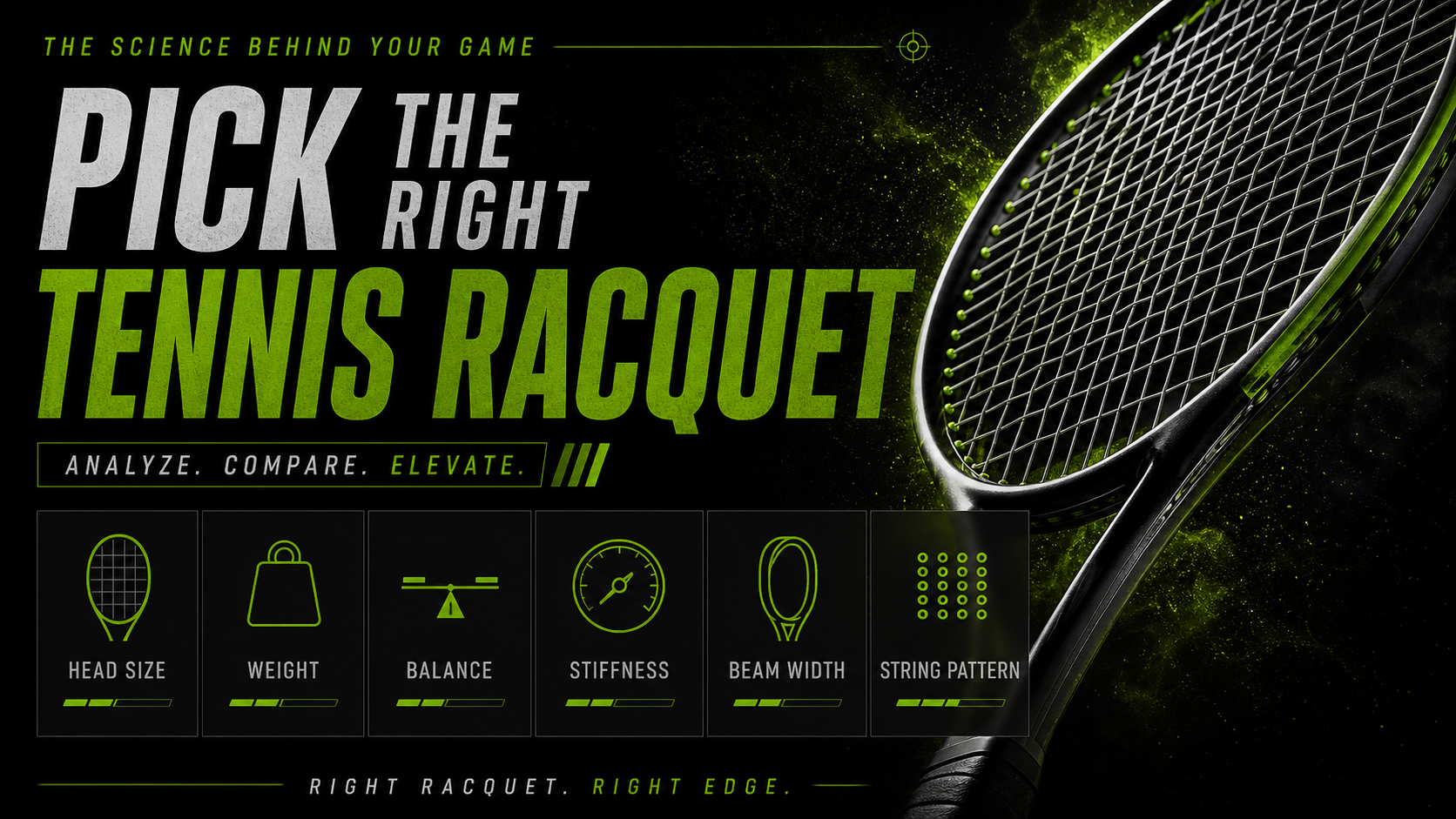
Choosing a tennis racquet based on brand loyalty or how it looks is like choosing a running shoe by colour. Every specification on a racquet — head size, weight, balance, beam width, string pattern, stiffness — creates a measurable, predictable effect on how the ball responds. Once you understand the science, the right racquet becomes obvious.
This guide covers every major specification in depth: what it is, how it works physically, and what it means for your game. The final section translates all of this into a practical framework matched to playing level and style.
Tennis racquet technology is more nuanced than padel, because racquets are strung — meaning the string bed, not a solid foam core, is the primary ball contact surface. This introduces an additional layer of variables: string type, tension, and pattern all interact with the racquet’s physical specs to produce the final performance profile. This guide covers the racquet frame itself; string selection is addressed separately.
01 Head Size
Head size is the area of the string bed, measured in square inches (in²) or square centimeters (cm²). It is one of the most impactful specifications on the racquet — directly determining sweet spot size, power potential, and how the racquet rewards or punishes off-center contact.
Standard head size categories:
- Midsize: 85–97 in² (548–625 cm²)
- Mid-plus: 98–104 in² (632–671 cm²)
- Oversize: 105–115 in² (677–742 cm²)
- Super oversize: 116 in² and above
Midsize: 85–97 in²
A smaller string bed concentrates string mass and reduces the moment of inertia of the string plane. The sweet spot is smaller and more precisely located — demanding consistent technique on every shot. When contact is on-center, the response is crisp and direct with excellent feedback. Off-center hits lose significant power and feel notably different.
Smaller head sizes also produce a denser string pattern (more cross strings per inch), which reduces string movement and increases control and precision — at the cost of spin generation. These racquets are the traditional choice of flat, technical baseliners and serve-and-volley players who place the ball with surgical accuracy.
Best for: advanced and professional players with established, repeatable technique.
Mid-Plus: 98–104 in²
The dominant category in modern professional and advanced recreational tennis. Large enough to provide meaningful forgiveness on slightly off-center hits, but compact enough to preserve the control and directional precision that advanced play demands. The 100 in² format has become the de facto standard for high-performance racquets across all major brands.
This range also supports open string patterns (16×19, 16×18) that maximize string movement and spin generation — a key factor in the modern topspin-dominant baseline game. Most ATP and WTA professionals play within this range.
Best for: intermediate to professional players across all play styles.
Oversize: 105–115 in²
A larger string bed means a larger sweet spot, greater forgiveness, and more trampoline effect from the string bed. For players with shorter, more compact swings — or those who do not yet consistently contact the ball in the center of the face — oversize heads provide access to power that the player’s technique may not yet generate independently.
The tradeoff is reduced maneuverability (more air resistance, higher swing weight for the same frame weight), reduced control precision, and less feedback from off-center hits. String patterns tend to be more open, which increases spin potential but reduces durability.
Best for: beginners, recreational players, players with arm injuries, seniors.
WHY HEAD SIZE AFFECTS POWER
Power in a tennis racquet comes primarily from the string bed’s elastic deformation — the trampoline effect. A larger string bed has longer strings with greater elasticity (strings behave like springs: longer spring = more stretch for the same force). This means the ball deforms the string bed more deeply and receives more energy back on rebound. Larger head = longer strings = more elastic energy return = more power for the same swing speed.
02 Weight
Tennis racquet weight is measured unstrung, typically between 255g and 365g. Strung weight adds approximately 15–20g depending on string gauge and tension. Weight interacts with balance and swing weight to produce the racquet’s overall feel — these three specs must always be read together.
Standard weight categories:
- Lightweight: 255–280g — primarily for beginners and players with arm issues
- Medium: 280–300g — the broad performance range for most players
- Heavy: 300–340g — traditional players’ racquets, demanding technique
- Extra heavy: 340g+ — specialist frames, rare in modern designs
Lightweight: 255–280g
Lighter frames swing faster, generating higher racquet head speed for the same muscular effort. Theoretically this allows greater ball speed — but in practice, the lower mass means less stability on off-center hits and less resistance to the ball’s force on impact. The racquet deflects more, reducing energy transfer efficiency.
Manufacturers compensate with larger head sizes, stiffer frames, and thicker beams — all of which increase power from other sources. Lightweight racquets are forgiving and easy to maneuver but can feel unstable against hard-hitting opponents.
Medium: 280–300g
The standard range for recreational through professional players. Enough mass to provide stability and efficient energy transfer without demanding exceptional physical strength to maneuver. Most professional models — the Wilson Pro Staff, Babolat Pure Strike, HEAD Gravity Pro — cluster between 295g and 315g unstrung.
Within this range, the distinction between 285g and 305g is significant: a 20g difference in a tennis racquet, where the weight is distributed across a long lever arm, translates to a meaningful difference in swing weight and feel.
Heavy: 300–340g
Traditional players’ racquets — the tools used by earlier generations of professionals playing with natural gut and thin beams. Heavier frames provide superior stability on impact, resist twisting on off-center hits (greater polar moment of inertia), and transfer more mass-derived energy into the ball.
They require a longer, more complete swing to generate pace. Defensive, compact, or late-contact shots produce less power because the player cannot swing the heavier frame as fast. For technically correct players with full, smooth swings, heavy frames reward with exceptional feel and ball control.
SWING WEIGHT VS. STATIC WEIGHT
Static weight (what the scale reads) is not how heavy a racquet feels during play. Swing weight — technically Moment of Inertia (MOI) around the handle axis, measured in kg·cm² — determines how much effort is required to swing the racquet. A 300g head-heavy racquet can have a higher swing weight than a 320g handle-heavy racquet. Swing weight is the most accurate single predictor of how a racquet will feel in motion, but few brands publish it. It can be calculated: MOI = mass × (balance point distance)².
03 Swing weight
Swing weight is the most accurate single measure of how a racquet actually feels in motion. It is the Moment of Inertia (MOI) of the racquet calculated around the axis of rotation at the handle — typically measured at 10 cm from the butt end — and expressed in kg·cm² or RDC units.
Unlike static weight, swing weight accounts for the distribution of mass along the racquet’s length. Two racquets with identical static weight and balance can have measurably different swing weights depending on how mass is distributed along the shaft and frame.
Reference ranges:
- Below 300 kg·cm²: Very maneuverable — common in lightweight power racquets
- 300–315 kg·cm²: Light to medium swing weight — recreational to intermediate
- 315–330 kg·cm²: Medium swing weight — most performance all-rounders
- 330–345 kg·cm²: Heavy swing weight — traditional players’ racquets
- Above 345 kg·cm²: Very heavy — specialist frames, tour-level players
Why Swing Weight Matters More Than Static Weight
When you swing a racquet, you are rotating a mass around a pivot point (your shoulder and wrist). The resistance you feel is not from the raw weight — it is from the distribution of that weight relative to the pivot. A 290g frame with 10 points head-heavy balance can produce a swing weight of 330 kg·cm² — identical to a 320g frame that is 3 points head-light. They feel the same in motion despite a 30g static weight difference.
Higher swing weight provides more stability on impact (harder to deflect by an incoming ball) and more power from mass momentum — but demands more physical effort to accelerate through each swing. This is the key tradeoff in swing weight selection.
CUSTOMIZATION THROUGH WEIGHTING
Experienced players and technicians often customize swing weight by adding lead tape to specific racquet zones. Lead tape at the 3 and 9 o’clock positions (head) increases swing weight and stability — improving performance on groundstrokes. Lead tape at the 12 o’clock position (top of head) creates a more head-heavy balance — amplifying serve power. Lead tape at the handle (under the grip) reduces swing weight while maintaining static weight — improving maneuverability without losing mass on impact. This is how touring professionals fine-tune their frames to precise specifications.
04 Balance
Balance point is measured in millimeters from the butt of the handle. It describes where the racquet’s mass is concentrated. Standard tennis racquets are approximately 685mm long, so a balance point of 320mm is exactly neutral (called ‘even balance’). Most racquets are measured in points — 1 point = 3.175mm — relative to neutral.
A racquet 5 points head-heavy sits 5 × 3.175mm = ~16mm above neutral. A racquet 3 points head-light sits ~10mm below neutral.
Head-Heavy Balance
Mass concentrated in the head increases angular momentum through the swing arc. For the same muscular effort and swing speed, a head-heavy racquet delivers more force at impact — producing more power on groundstrokes and serves. It feels more stable against powerful incoming shots.
The penalty is slower recovery between shots, reduced maneuverability at the net, and greater arm fatigue over long matches due to the increased rotational force on the wrist and elbow during every swing. Head-heavy balance is most common in lightweight power racquets — the extra head mass compensates for the lighter overall frame.
Even Balance
Balanced frames feel neutral — neither particularly powerful nor particularly maneuverable. They reward all-round play and are the most adaptable to different court positions and shot types. Even balance is common in mid-weight all-round racquets and most intermediate performance models.
Head-Light Balance
Mass concentrated near the handle reduces the moment of inertia, making the racquet faster through the air and more responsive to wrist action. Head-light frames are significantly easier to maneuver — critical for net play, defensive retrieval, and high-pace exchanges where reaction time is compressed.
Traditional heavy players’ racquets are almost always head-light: the additional frame mass provides the power, while the handle-heavy balance keeps swing weight manageable and reduces arm stress. The Wilson Pro Staff 97 and Babolat Pure Strike 18×20 are archetypal examples.
WHY MOST POWER RACQUETS ARE HEAD-HEAVY
Power racquets are designed to help players who cannot generate pace through technique alone. They compensate with: large head size (longer strings, more trampoline effect), light overall weight (faster swing speed possible), and head-heavy balance (more angular momentum for the same swing speed). These three specs work together to deliver effortless power — at the cost of feel, stability, and precision.
05 Beam width
Beam width refers to the thickness of the racquet frame cross-section — the ‘wall’ of the racquet as viewed from the edge. It is measured in millimeters and is one of the most direct indicators of a racquet’s stiffness and power character.
Modern racquets range from 19mm to 28mm. Some racquets use variable beam width — thicker at the throat, thinner at the shoulders — to engineer different flex characteristics at different frame zones.
Thin Beam: 19–22mm
Thin beams flex more on ball contact. This flex absorbs some of the impact energy — reducing power but also reducing the shock transmitted to the arm. The string bed does more of the work. Thin beam frames have a ‘softer’ feel and produce superior ball feedback — the player can feel the quality of contact more directly.
Thin beams are the signature of players’ racquets. The Wilson Pro Staff 97 (21mm), HEAD Prestige MP (21mm), and Babolat Pure Strike (23mm) are all thin-beamed by modern standards. They demand quality technique because flex means inconsistency when contact is imprecise.
Medium Beam: 23–25mm
A compromise between flex and rigidity. Provides more power than thin beams through increased frame stiffness, while remaining significantly more comfortable and controllable than thick-beam power frames. The most common beam width in all-round performance racquets, covering the majority of intermediate to advanced recreational players.
Thick Beam: 26–28mm+
Thick beams are rigid. On ball contact, very little energy is absorbed by frame flex — almost all of it is returned to the ball through the string bed. The result is significant power amplification without additional swing effort. This is the defining characteristic of power and tweener racquets.
The tradeoff is a harsher impact feel, higher vibration transmission to the arm, reduced feedback, and a less precise ball response. Players with existing arm conditions should approach thick-beam frames with caution.
BEAM WIDTH AND ARM HEALTH
Frame stiffness is the primary driver of vibration transmission to the arm. Thick, rigid beams act as efficient conductors of impact shock from ball to frame to hand. This is a significant contributing factor to tennis elbow and other upper limb injuries. Players with existing arm conditions — or those playing high volumes — should prioritize thin or medium beams, soft strings (natural gut or multifilament), and moderate string tension. These choices collectively reduce peak impact force on the arm by a measurable margin.
06 Frame stiffness (RA rating)
The RA rating (measured on specialized such as the Babolat RDC) is a standardized measure of frame stiffness — how much the frame deflects under a fixed load. It is one of the most scientifically precise specifications available for tennis racquets. Most brands traditionally did not publish it, it could be found through independent testing. Recently, more brands have adapted the practice of publishing stiffness ratings of their racquets onto their official websites.
RA scale reference:
- Below 55 RA: Very flexible — exceptional feel, low power, very arm-friendly
- 55–62 RA: Flexible to medium — players’ racquets, good feel and control
- 63–67 RA: Medium stiff — balanced performance, all-round category
- 68–72 RA: Stiff — high power output, increased vibration
- 73+ RA: Very stiff — maximum power, harsh feel, high injury risk
Low RA: Under 62
Flexible frames deform more on ball contact — storing elastic energy in the frame itself and releasing it over a slightly longer contact time (increased dwell time). This extends the player’s window of influence over the shot and produces excellent feel and precision. The cost is reduced power output from the frame — the player must generate pace through swing speed and string selection.
Low-RA racquets are the choice of professionals and advanced players who prioritize feel, control, and arm health. Historical players’ racquets — the classic Wilson Pro Staff 6.0 85, for example — had RA values in the low 50s. Modern low-RA options include the HEAD Prestige series (~58–62 RA) and Yonex VCORE Pro 97 (~60 RA).
Medium RA: 63–67
The performance sweet spot for most players. Enough rigidity to provide power assistance without the harsh impact character of high-RA frames. Medium stiffness is the most versatile — it accommodates a wide range of string types and tensions, and responds well to both heavy topspin and flat hitting styles.
High RA: 68 and Above
Stiff frames are efficient energy conductors. Less energy is lost to frame flex — more is transferred directly to the ball. The string bed does most of the work. High-RA racquets are the power tools of the racquet world: they amplify ball speed without requiring aggressive swings.
The significant downside is vibration. A rigid frame transmits more impact shock to the wrist and elbow. Combined with polyester strings at high tension — which many recreational players use — high-RA frames can significantly increase injury risk for players who lack the physical conditioning to manage that load.
RA AND STRING TENSION INTERACTION
Frame stiffness and string tension interact to determine the total system stiffness — what players actually feel on contact. A stiff frame (70+ RA) strung at low tension (45 lbs) may feel softer than a flexible frame (58 RA) strung at high tension (60 lbs). This is because string tension has a powerful effect on string bed stiffness. Players should always consider RA and string tension together when targeting a specific performance feel.
07 String pattern
The string pattern describes the number of main strings (vertical) and cross strings (horizontal) woven into the string bed. The most common patterns in modern tennis are 16×19, 16×18, 18×20, and 16×15. This specification determines string spacing — which is the primary mechanical driver of spin generation.
Open Pattern: 16×19 / 16×18
Open string patterns have fewer strings per unit area — meaning the gaps between strings are larger. When the ball contacts an open pattern, individual strings deflect laterally further before the ball leaves the string bed. This lateral deflection and snap-back transfers angular momentum to the ball — producing topspin and slice.
16×19 is the dominant professional string pattern. Virtually every major ATP topspin baseliner plays a 16×19 or equivalent open pattern. Nadal’s Babolat Aero (16×19), Djokovic’s HEAD Speed Pro (16×19), and Alcaraz’s Wilson Blade (16×19) are archetypal examples.
Open patterns also feel more powerful — longer strings stretch more, increasing the trampoline effect. The tradeoff is faster string wear and breakage, particularly with monofilament polyester strings.
Dense Pattern: 18×20
More strings per unit area means smaller gaps, less lateral string movement, and less trampoline effect. The ball is held more precisely on the string bed — producing superior directional control. The dense pattern is the format of flat hitters and serve-and-volley players who prioritize placement precision over spin generation.
18×20 racquets are commonly associated with the traditional serve-and-volley generation. Federer played a 90 in² / 18×20 racquet for most of his career. The pattern rewards clean, flat ball-striking. It is more durable — the reduced string movement means strings wear more slowly.
The penalty is a stiff, board-like feel at high tension and reduced access to heavy topspin — a significant limitation in modern baseline tennis where spin generation is a fundamental weapon.
Extreme Open Pattern: 16×15 / 14×16
Specialist patterns with very large gap spacing. Designed to maximize spin generation and string movement to an extreme degree. Found in select spin-optimized models. Strings break very quickly under polyester construction and demand either natural gut or multifilament for durability.
THE PHYSICS OF SPIN
String deflection during ball contact follows Hooke’s Law — force is proportional to displacement. In an open pattern, each string has greater freedom to deflect laterally. As the string bed deforms under the ball, strings snap back with angular velocity — transferring rotational energy to the ball as topspin or slice. The Magnus effect then causes the spinning ball to curve: topspin produces downward curve (high net clearance possible at higher trajectory), slice produces side drift and low bounce. Open patterns amplify this effect; dense patterns suppress it in favor of linear precision.
08 Racquet length
Standard tennis racquets are 27 inches (686mm) long. Extended length racquets — typically 27.5 to 29 inches — are permitted under ITF rules (maximum 29 inches / 737mm). Extended length changes the physics of the serve and groundstroke in fundamental ways.
Standard Length: 27 inches
The universal format for professional and competitive tennis. Optimized for control, maneuverability, and the leverage mechanics that centuries of tennis technique have been built around. Virtually all professional players use standard-length racquets — including all ATP and WTA touring professionals.
Extended Length: 27.5–29 inches
Extended length increases the lever arm from the hand to the contact point. By the same physics that makes a longer wrench turn a bolt more easily, a longer racquet applies more torque to the ball during a serve or groundstroke — generating more ball velocity for the same muscular effort.
The serve benefit is the most significant: a longer racquet contacts the toss at a higher point, adding more leverage and reach. Extended-length racquets can produce notably faster serves for players who cannot generate pace through flexibility or technique.
The tradeoffs are real: longer frames are harder to maneuver (higher swing weight), more difficult to control precisely, and less responsive in net exchanges. They also require adjustment to swing mechanics — many players find their timing disrupted when switching from a standard frame.
Best for: players who struggle to generate serve pace, recreational players who prioritize serving as their primary weapon.
THE LEVER ARM PRINCIPLE
Torque = Force × Distance. For a serve, the relevant distance is from the shoulder pivot to the point of ball contact. A racquet 2 inches longer increases this distance — and therefore the torque produced by the same shoulder rotation — proportionally. For a player with a 28-inch arm and 27-inch racquet (55 inches total), adding 1.5 inches (28.5-inch racquet) represents approximately 2.7% more lever arm length. This translates directly to increased ball velocity on the serve.
09 Grip size
Grip size refers to the circumference of the handle. In the US and international market it is measured on a scale of L1 to L5 (or 1 to 5), with each increment representing approximately 1/8 inch (3.175mm) of additional circumference. In Europe, grips are often numbered 0–5 or described in millimeters (100–116mm).
Grip size reference:
- L1 (4 1/8″): ~100mm circumference — small hands, many women players
- L2 (4 1/4″): ~103mm — the most common recreational size
- L3 (4 3/8″): ~106mm — the most common professional size
- L4 (4 1/2″): ~109mm — larger hands
- L5 (4 5/8″): ~113mm — uncommon, large hands
Choosing Grip Size
The traditional method: hold the racquet in an Eastern forehand grip. Slide the index finger of your non-dominant hand into the space between the fingers and the palm. One finger should fit comfortably with a small amount of resistance. Too much space indicates a grip too large; no space indicates too small.
A grip that is too small requires the player to grip harder — increasing forearm muscle tension and contributing to tennis elbow risk. It also allows the handle to rotate more freely in the hand on off-center hits, reducing control.
A grip too large restricts wrist movement — reducing the ability to roll the wrist through topspin groundstrokes and serve pronation. Directional precision and spin generation are both impaired.
Overgrip adds approximately 0.5–1mm per wrap to the grip circumference. Most players use one to three overgrips to fine-tune their preferred size. It is standard practice to purchase a grip size slightly smaller than needed and build up with overgrip — since grip can be added but not removed from the handle.
GRIP SIZE AND INJURY RISK
Studies in sports medicine have found a correlation between grip size and lateral epicondylitis (tennis elbow). Too small a grip increases the wrist/forearm muscle activation required to prevent rotation, creating chronic overuse stress on the extensor tendons. The optimal grip size minimizes unnecessary muscular tension while maintaining adequate control. When in doubt, test both a target size and the next size up with actual ball striking — the difference in feel is immediately apparent.
10 Frame composition
Modern tennis racquets are constructed from carbon fiber composites. The engineering of these composites — fiber count, weave orientation, resin composition, and additional reinforcements — determines the frame’s stiffness, weight, vibration character, and durability.
Graphite / Carbon Fiber
The universal material for modern performance racquets. Carbon fiber provides an exceptional strength-to-weight ratio — significantly stiffer and lighter than the aluminum and wood frames it replaced in the 1980s. The specific properties of carbon fiber frames vary based on the fiber modulus (stiffness of individual fibers), layup orientation, and manufacturing precision.
High-modulus carbon fibers produce stiffer, lighter frames — but are more brittle and expensive. Standard-modulus carbon is more forgiving of manufacturing variation and impact stress.
Graphene-Reinforced Carbon
HEAD pioneered the use of graphene reinforcement in racquet manufacturing. Graphene — a single-atom layer of carbon in hexagonal lattice structure — has extraordinary tensile strength and stiffness per unit mass. Incorporating graphene into the composite allows frame mass to be redistributed away from the throat and shaft (where it contributes less to swing performance) toward the head and handle (where it has a greater effect on swing weight and stability). The result is better weight distribution efficiency without changing total frame mass.
Basalt / Innegra Composites
Basalt fiber (volcanic rock-derived) and Innegra (polypropylene fiber) are used in combination with carbon fiber specifically to manage vibration. Both materials have high damping characteristics — they absorb and dissipate vibration energy rather than transmitting it through the frame to the player’s hand. Racquets using these composites offer a meaningfully more comfortable impact feel without significant compromise to stiffness or power output.
Aluminum
Found exclusively in entry-level and children’s racquets. Aluminum is heavier and less stiff than carbon fiber but is inexpensive and durable enough for learning contexts. Adult players should not use aluminum-frame racquets for regular play — the additional weight and flex create mechanical inefficiencies that reinforce poor technique and increase arm stress.
CARBON FIBER MODULUS
Modulus describes the stiffness of carbon fiber at the material level — how much force is required to produce a given amount of deformation. Standard modulus fibers (around 230 GPa) are used in most recreational racquets. High modulus (290–350 GPa) and ultra-high modulus (350+ GPa) fibers produce stiffer, lighter frames with a crisper feel. These higher-spec materials are found in professional models and command a significant price premium. The tradeoff is increased brittleness — high-modulus carbon is more susceptible to cracking from impact with courts, walls, and mishits.
11 Significance of string tension
String tension — measured in pounds (lbs) or kilograms (kg) — is the only racquet specification that the player controls directly and can change between matches. It fundamentally alters the performance character of any racquet frame. Understanding how tension interacts with the frame’s stiffness is critical to optimizing your setup.
Standard tension ranges:
- Low tension (40–50 lbs): More power, more comfort, less control, more spin
- Medium tension (51–57 lbs): Balanced performance — the most common range
- High tension (58–65 lbs): More control, less power, more precision, harder on arm
- Very high tension (66+ lbs): Specialist use only — maximum control, significant arm risk
Low Tension: More Power and Comfort
At lower tension, strings deflect more deeply on ball contact and rebound with greater elastic energy — the trampoline effect is maximized. The contact time (dwell time) is extended, giving the player more time to influence shot direction. Vibration transmission to the arm is reduced because the strings absorb more of the impact energy.
Lower tension also increases string movement (on open patterns especially), amplifying topspin generation. The reduction in control at low tension is manageable for most recreational players — precision comes from swing mechanics, not from tight strings.
High Tension: More Control and Precision
Higher tension reduces string deflection. The ball leaves the string bed faster and with less energy amplification — the trampoline effect is suppressed. This translates to more predictable ball placement and the ability to swing hard without fear of hitting long. Elite players who generate enormous racquet head speed use high tension to prevent the ball from flying past the baseline.
The significant penalty is increased vibration. At high tension, strings transmit more impact shock into the frame — and the frame into the arm. Combined with stiff frames and polyester strings, high tension is one of the leading contributors to tennis elbow in recreational players.
THE TENSION PARADOX
Higher tension does not mean more control for players who lack the swing speed to compress the string bed on their own. True string bed compression — where the player’s swing speed is high enough to drive the ball into the strings and exploit the trampoline effect — only occurs reliably above approximately 80 mph of racquet head speed. Below this threshold, lower tension often produces better control for recreational players because the string bed provides a more consistent and forgiving response. This is why professional recommendations (typically 52–58 lbs) are often too high for recreational players who would benefit more from 46–52 lbs.
12 Player decision framework
Combining all specifications into a practical racquet selection framework. The consistent theme across all specs is a power/control tradeoff — and the correct choice depends entirely on your current level of technique, physical profile, and style of play.
Beginner — Maximize Forgiveness
- Head size: 105–115 in² — large sweet spot, tolerates off-center contact
- Weight: 255–275g unstrung — easy to swing, reduces fatigue
- Balance: Head-heavy or even — power assistance without technique
- Beam width: 26–28mm — stiff frame for effortless power
- String pattern: 16×19 — open for spin and power
- Length: 27 inches — standard for consistent technique development
- Grip size: Measure carefully — critical for arm health from the start
- Recommended RA: 65–70 — stiff for power, acceptable for low-volume play
- Tension: 46–52 lbs — low for maximum comfort and power
Intermediate — Build Toward Performance
- Head size: 100–105 in² — beginning to demand precision
- Weight: 280–300g unstrung — adding mass for stability
- Balance: Even to slightly head-light — improving maneuverability
- Beam width: 23–26mm — reducing from power frame toward all-round
- String pattern: 16×19 — retains spin and power access
- RA: 63–68 — medium stiffness, balanced feel
- Tension: 48–55 lbs — finding personal feel preference
Advanced: All-Round Player
- Head size: 98–104 in² — performance window with workable sweet spot
- Weight: 295–315g unstrung — full performance weight range
- Balance: Head-light to even — maneuverability prioritized
- Beam width: 21–24mm — thin to medium for feel and control
- String pattern: 16×19 or 16×18 — spin and power available
- RA: 58–65 — flexible to medium for feel and arm health
- Tension: 50–58 lbs — individual preference by playing style
Advanced: Control / Flat Hitter
- Head size: 93–98 in² — precision demands consistent technique
- Weight: 305–330g unstrung — mass for stability and feel
- Balance: 5–8 points head-light — maximum maneuverability
- Beam width: 19–22mm — thin beam for exceptional feel
- String pattern: 18×20 — dense for directional precision
- RA: 55–62 — flexible frame for arm-friendly, feel-rich response
- Tension: 52–60 lbs — higher end for flat hitting precision
Advanced: Spin / Topspin Baseliner
- Head size: 98–104 in² — support for open stance, heavy spin game
- Weight: 290–315g unstrung
- Balance: Even to slightly head-heavy — power on groundstrokes
- Beam width: 22–26mm — medium for power and spin combination
- String pattern: 16×19 or 16×18 — open for maximum spin generation
- RA: 60–68 — medium stiffness supports aggressive swing
- Tension: 46–54 lbs — lower tension amplifies spin and trampoline effect
THE MOST IMPORTANT RULE
Technique matters more than equipment. A well-struck ball with a beginner’s racquet will outperform a poorly struck ball with a professional’s racquet every time. The right racquet does not fix technique — it amplifies it. Choose a racquet that matches your current game, not your aspirational game. As your technique develops, your ideal racquet profile will shift — lighter, thinner, smaller, more control-oriented. That shift is evidence of progress.
About RacquetID
RacquetID is a Tennis and Padel specialist based in Ho Chi Minh City, Vietnam. We assign every racquet in our range a unique identity name — because choosing a racquet should feel like finding your game, not reading a catalogue. Visit us at racquetid.com.