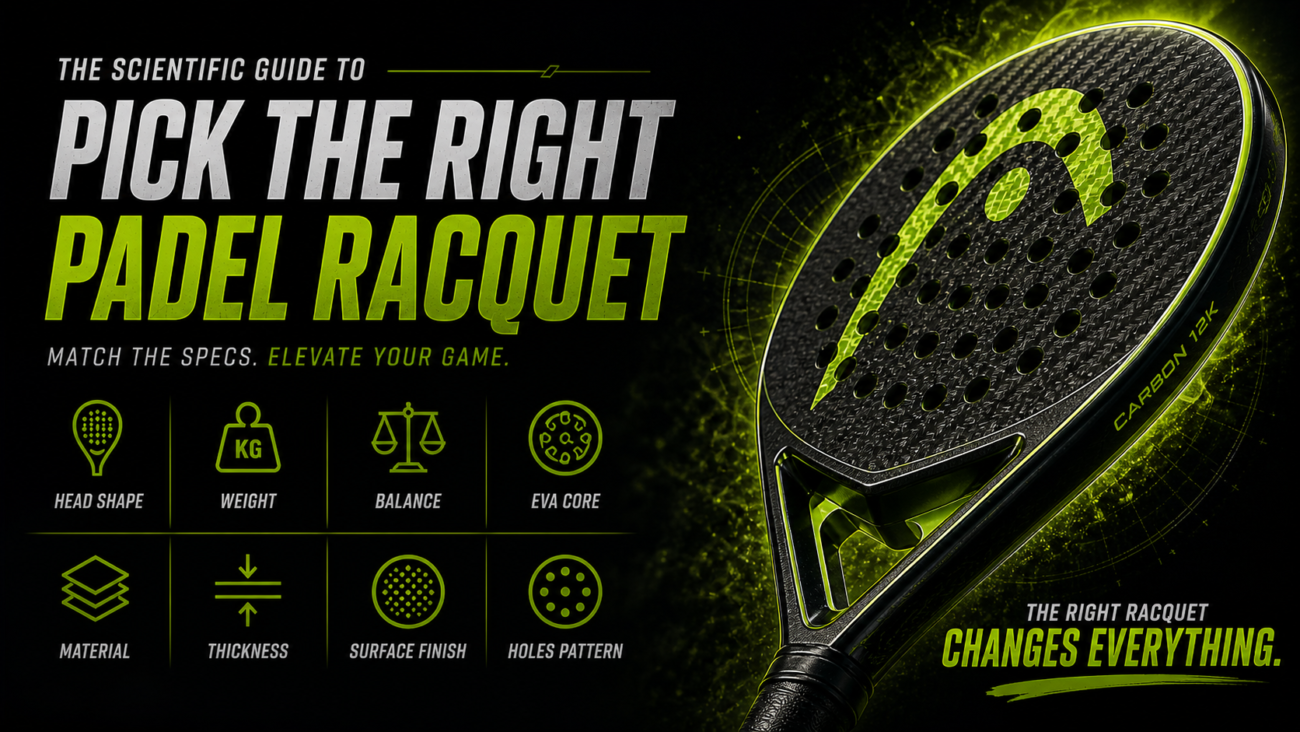


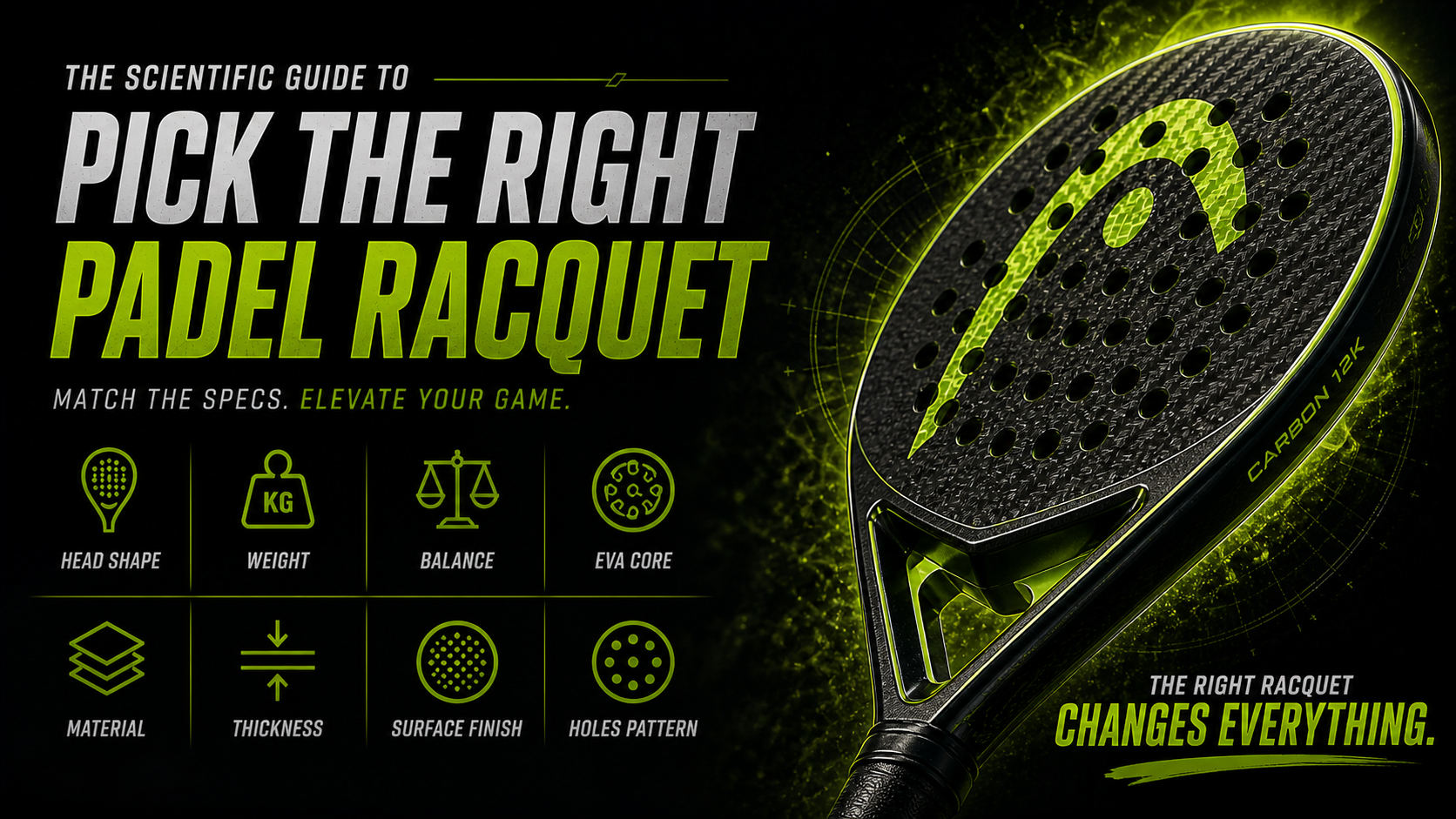
Choosing a padel racquet is one of the most consequential decisions you can make as a player — and one of the most misunderstood. Most players choose based on brand loyalty, aesthetics, or which racquet their club pro uses. This guide takes a different approach.
Every millimeter, every gram, every material decision changes how a racquet performs. This guide breaks down the science behind each specification, explains exactly how it affects power, control, comfort, spin, and precision — and tells you what to prioritize based on your level and style of play.
By the end, you will have everything you need to choose a padel racquet on your own terms.
01 Head Shape
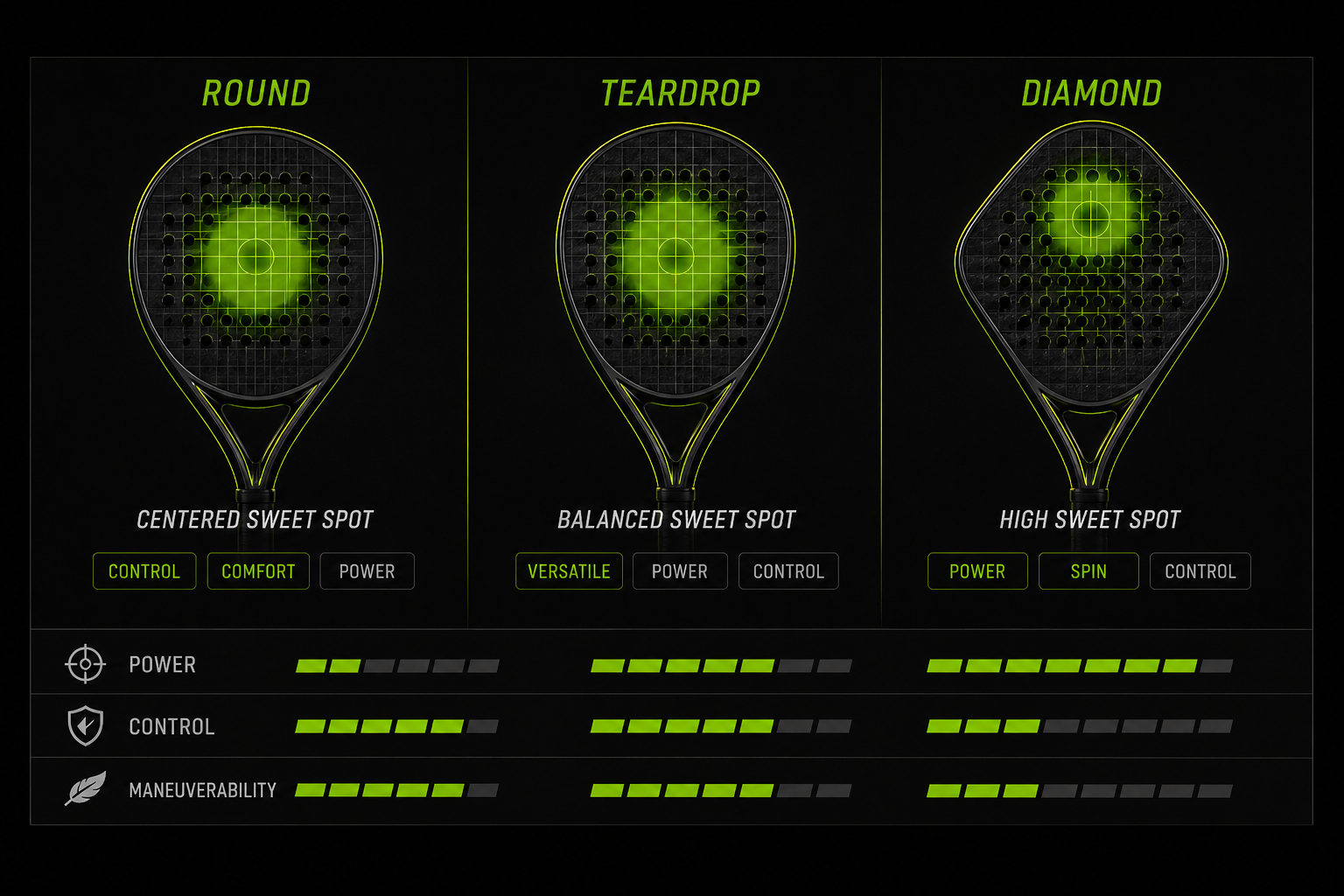
The head shape is the most consequential spec on a padel racquet. It determines where the sweet spot is located, how forgiving the racquet is on off-center hits, and what style of play it rewards. Everything else about a racquet's character flows from this decision.
Round
A round head shape positions the sweet spot directly in the center of the hitting face. Because the center is equidistant from all edges of the frame, the racquet is highly stable on off-center hits — the torque (rotational force applied to your wrist when you miss the sweet spot) is minimized, reducing the penalty for imprecise contact.
Round racquets reward control and touch. They are ideal for players who prioritize precise ball placement, net volleys, and defensive consistency over raw power. Because the sweet spot is lower on the face, the lever arm to generate power is shorter — meaning you must supply more of the pace yourself through technique.
Best for: control players, beginners, defensive specialists, and players with existing arm issues.
Teardrop
The teardrop shape is a hybrid between round and diamond. The sweet spot sits in the upper-center of the face — higher than a round but lower than a diamond. This gives players access to more natural power than a round racquet while maintaining a reasonably large and forgiving hitting zone.
Most intermediate and advanced all-round racquets use a teardrop shape. It is the most versatile format — equally capable at the net and from the back of the court, suitable for smashes and volleys without demanding the precision that diamond shapes require.
Best for: intermediate to advanced players, all-rounders, players transitioning from round to power racquets.
Diamond
The diamond shape pushes the sweet spot high into the upper third of the face. This dramatically increases the lever arm from the hand to the impact point — generating significantly more angular momentum through the swing. The result is maximum power potential, particularly on smashes, bandeja, and vibora shots.
The tradeoff is unforgiving precision requirements. Missing the sweet spot on a diamond racquet transmits far more torque to the wrist and elbow than a round or teardrop. It also makes fast net exchanges harder — the high balance point slows racquet recovery between volleys.
Best for: advanced and professional players with consistent, technically correct swings who prioritize pace generation.
THE PHYSICS
A higher sweet spot creates a longer lever arm between the hand pivot and the point of contact. By Newton's second law of rotation (torque = force × distance), the same muscular effort produces greater angular momentum — and therefore greater ball velocity — when the contact point is further from the axis of rotation. This is why diamond racquets generate more power without the player swinging harder
02 Weight
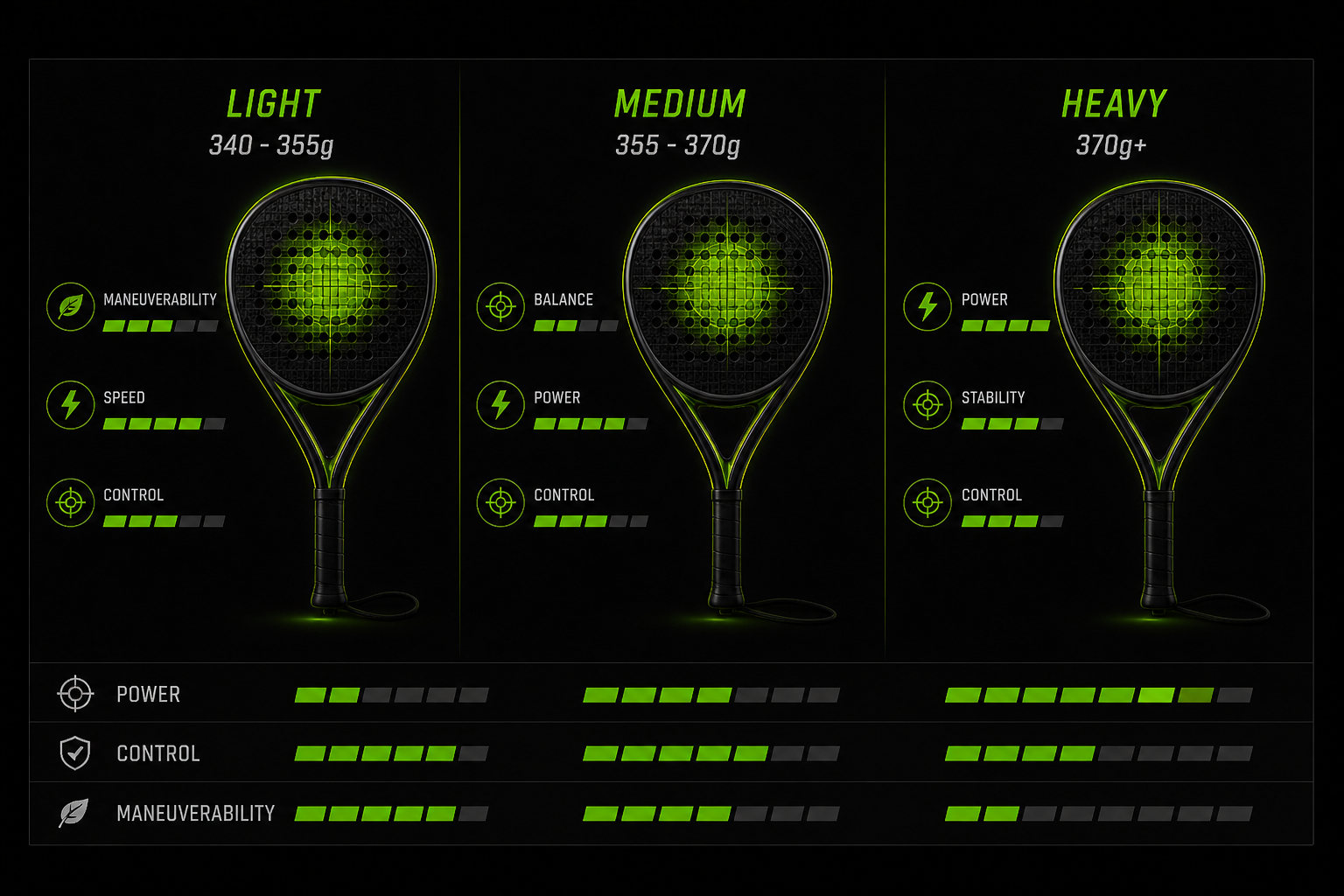
Padel racquets typically range from 340g to 395g. Weight affects swing speed, power transfer, stability on impact, and arm fatigue across a match. Unlike tennis racquets, padel frames are sealed rigid structures — weight distribution cannot be fine-tuned after purchase.
Light: 340–355g
Lighter racquets swing faster, are easier to maneuver at the net, and generate significantly less fatigue over long matches or training sessions. The tradeoff: lower mass means less kinetic energy transferred to the ball on impact. Power must come from the player's swing speed and technique rather than from the racquet's mass.
Light racquets are recommended for players with elbow or shoulder injuries, beginners who have not yet developed consistent technique, players who play multiple times per week and prioritize recovery, and net-dominant players who need fast reflexes in exchanges.
Medium: 355–370g
This is the performance sweet spot for most players. Enough mass to stabilize on powerful shots and wall rebounds without sacrificing the quick wrist movement needed for net exchanges. The vast majority of mid-range and high-performance padel racquets fall into this category. Manageable for daily play without the recovery demands of heavier frames.
Heavy: 370–395g
Heavy racquets maximize mass transfer on contact. They are particularly effective on smashes, where the combination of high balance, heavy head, and strong swing generates extreme ball velocity. They also provide superior stability when receiving pace-heavy shots from opponents.
The significant demands of a heavy racquet — slower net recovery, higher joint stress, greater fatigue — make them appropriate only for physically conditioned advanced players who understand the risks.
THE PHYSICS
Kinetic energy on impact = ½mv² where m is mass and v is swing velocity. A heavier racquet has more m, but generates lower v due to the increased effort required to swing it. A lighter racquet achieves higher v but with lower m. The optimal weight for maximum power output varies by individual player strength. Stronger players can maintain swing speed with heavier frames and gain from the mass advantage; weaker players lose more to reduced swing speed than they gain from the additional mass.
03 Balance
Balance point is measured in millimeters from the base of the handle and describes where the racquet's mass is concentrated. Most padel racquets are 455–465mm in total length. A balance point of 255–265mm is considered neutral. This specification often has more practical impact on how a racquet plays than its raw weight.
High Balance: Head-heavy (265mm and above)
When mass is concentrated above the midpoint, the racquet's angular momentum increases through the swing arc. This translates to more natural power on drives and overhead smashes without additional muscular effort. It behaves similarly to a heavier racquet in terms of swing feel, despite potentially lighter raw weight.
The penalty is slower racquet recovery between shots. A head-heavy racquet that has completed a swing takes more time and effort to reposition for the next shot — a serious liability in fast net exchanges.
Neutral Balance (255–265mm)
Mass distributed evenly between handle and head. Predictable and adaptable — the easiest balance profile to adjust to when switching racquets. Reduces rotational torque on off-center hits. The most common balance profile in all-round and beginner-to-intermediate racquets.
Low Balance: Handle-heavy (below 255mm)
Mass concentrated near the handle reduces the moment of inertia — making the racquet feel lighter during the swing than its raw weight suggests. Wrist mobility and reaction speed are dramatically improved. At the net, a handle-heavy racquet allows faster redirections, better disguise on deflections, and quicker reset after volleys.
The reduced head mass limits natural power generation from the swing itself. Control players who dominate from the net consistently favor low-balance racquets.
WEIGHT × BALANCE COMBINED
A light racquet with a high balance point can produce the same swing weight (Moment of Inertia) as a heavy racquet with a low balance point. These two racquets will feel identical in terms of power generation — despite potentially having different raw weights by 20 or more grams. Always evaluate weight and balance together, not in isolation.
04 Core material
The foam core is the functional engine of a padel racquet. It determines how the ball behaves on impact — how much energy is stored, how much is returned, and how long the ball stays in contact with the face. Unlike tennis strings, the core cannot be replaced or adjusted. It is fixed at manufacture.
EVA Foam — The Performance Standard
EVA (Ethylene Vinyl Acetate) is the dominant core material in mid-range and high-performance padel racquets. Its closed-cell structure deforms slightly on ball contact and rebounds quickly — producing what players describe as a 'punchy' feel with good power feedback.
EVA exists on a density spectrum:
- Hard EVA produces more power, faster energy return, less ball dwell, and stronger vibration transmission. More demanding on the arm.
- Soft EVA increases ball dwell time, provides more control and touch, absorbs more vibration, and is significantly more comfortable. Preferred for control-oriented builds.
HR3 / Rubber Cores
High-resilience rubber composites (Bullpadel's proprietary HR3 is the most prominent example) behave similarly to hard EVA but with greater energy return efficiency. They are used in professional-level racquets to extract maximum power without the dead feel of the stiffest EVA grades. Excellent durability.
Polyethylene (PE) Foam
Softer, lower-density foam used in beginner and entry-level racquets. Produces the highest comfort and longest dwell time of any core material — giving beginners more time to direct the ball and reducing arm shock significantly. Power output is limited.
EPDB / Expanded Polyethylene
The lowest-density core option. Maximum comfort and control, minimal power. Found exclusively in beginner racquets. Degrades faster than EVA or rubber cores under frequent play.
DWELL TIME EXPLAINED
Dwell time is the duration of ball-face contact during a single impact — typically 3 to 8 milliseconds. Softer, lower-density cores compress more deeply and rebound more slowly, extending dwell time. Longer dwell time gives the player more time to influence direction, spin, and touch — increasing control. Harder cores compress less and rebound faster, reducing dwell time but releasing more energy — increasing power. This is the fundamental control/power tradeoff embedded in every core material decision.
05 Frame material
The frame is the rigid outer shell surrounding the foam core. It provides structural integrity, protects the core from impact and wall contact, and determines how much flex occurs when the ball strikes the face. Frame flex absorbs energy (comfort, control) — frame rigidity returns energy (power, precision).
Fiberglass
The most flexible and forgiving frame material. Fiberglass absorbs significant vibration on impact, making it the most comfortable option for players with arm sensitivity. Its natural flex produces a longer dwell time, supporting control. Power is limited by the energy lost to frame flex. Heavier per unit of rigidity than carbon. Standard in beginner and entry-level racquets.
Carbon Fiber (3k - 6k - 12k)
The entry point for carbon frames in performance racquets. Significantly stiffer than fiberglass — more energy is returned to the ball rather than absorbed by the frame. The 12k designation refers to 12,000 carbon fiber filaments per tow bundle. Standard in mid-range and many high-performance racquets. Offers a strong balance of power, feel, and manageable vibration levels.
Carbon Fiber (18k and 24k)
Higher filament count produces finer weave density and greater stiffness per gram. 18k and 24k carbon frames are found in top-tier professional racquets. They deliver maximum energy return on impact — translating directly to ball pace — at the cost of significant vibration transmission to the wrist and elbow. Not recommended for players with joint sensitivity.
Graphene and Innegra Composites
Graphene-reinforced carbon frames achieve ultra-high stiffness at extremely low weight. Innegra is a polypropylene fiber woven into composite frames to absorb shock and reduce vibration — often added specifically to counteract the high vibration of stiff carbon frames. These materials represent the current ceiling of padel frame technology, found in flagship professional models.
Carbon + Fiberglass Hybrid
A deliberate middle ground: carbon's rigidity in structural zones (frame edges) combined with fiberglass's comfort in the face. Produces excellent power without the harsh feel of all-carbon frames. A practical choice for advanced players who want performance without arm health compromise.
UNDERSTANDING CARBON K-RATING
The K number (12k, 18k, 24k) describes the number of carbon fiber filaments in each tow bundle used to weave the frame. Higher K = finer weave = greater stiffness and lower weight per surface area. 24k carbon fiber uses the same material specification as aerospace-grade structural composites. The stiffer the frame, the less energy it absorbs on impact — meaning more returns to the ball as pace. This also means more vibration is transmitted to the hand and arm.
06 Surface finish
The face surface — the hitting side of the racquet — is a thin sheet of fiberglass or carbon fiber laminated onto the foam core. The texture of this surface determines the friction coefficient between ball and face during contact, which directly controls spin generation potential.
Smooth / Polished Surface
A flat, polished surface has a low friction coefficient. The ball slides across the face more readily during contact, limiting the angular momentum transferred to the ball (spin). The result is a crisper, cleaner strike with more direct energy return — suited to flat hitting and precision placement.
Smooth surfaces are most commonly found on control-oriented and all-round racquets. They produce predictable, consistent ball response that technical players depend on.
Rough / Textured Surface
A textured surface — whether from exposed carbon weave, sand coating, or raised geometric patterns — increases friction on ball contact. The ball grips the face for a fraction longer, allowing more angular momentum to be transferred to the ball. The result is greater spin potential on topspin drives, viboras, slice shots, and kick serves.
Rough surfaces are the standard finish on power and spin-oriented racquets. They are particularly valued by players who generate ball movement as their primary tactical weapon.
SPIN GENERATION PHYSICS
Spin is generated when friction between ball and surface causes the ball to roll rather than slide during contact. Greater surface roughness increases the coefficient of kinetic friction (Ff = μk × N), extending the time the ball 'grips' the face. This longer grip transfers angular momentum to the ball, producing topspin, slice, or sidespin depending on swing direction. A worn, smooth face on an old racquet will produce measurably less spin than a fresh textured surface.
07 Holes pattern
All padel racquets are required by regulation to have perforated faces. But the size, number, placement, and distribution of those holes is not regulated — and it has significant engineering implications for aerodynamics, sweet spot geometry, and hitting surface flex.
Hole Size
Larger holes (9–11mm diameter) reduce the solid surface area of the face. This has two effects: it reduces air resistance during the swing, enabling faster swing speeds for the same effort; and it increases local flex in the face around each hole, slightly softening the feel.
Smaller holes (6–8mm) preserve more of the hitting surface, producing a larger effective contact area and greater stability on off-center hits. The racquet moves through air with slightly more resistance — a marginal effect at most playing speeds — but the face structure is more uniform and controlled.
Hole Distribution
How holes are arranged across the face affects where the sweet spot naturally falls. Brands engineer hole patterns to shift the sweet spot toward the center, compensate for head shape biases, or redistribute face flex in ways that change ball response across different zones of the face.
Asymmetric hole patterns — where holes are clustered or concentrated in specific zones — can intentionally offset the sweet spot to match the racquet's design philosophy.
Number of Holes
A higher total number of holes reduces overall face mass and air resistance, producing a livelier, faster-swinging racquet. Fewer, larger holes provide a heavier face feel with greater control character.
THE AERODYNAMICS
As a racquet swings through air, the drag force acting against it is described by F = ½ρCdAv², where A is the effective surface area facing the direction of swing. Reducing A through holes decreases drag force, allowing the same muscular effort to achieve higher swing velocity. Brands such as NOX and Bullpadel have experimented with aerodynamic slot and groove geometries specifically to reduce drag on the backswing without compromising face structural integrity.
08 Thickness
Padel racquet thickness — typically between 36mm and 38mm — refers to the depth of the foam core. Regulations cap maximum thickness at 38mm. A thicker core contains more foam volume, which changes the compression mechanics of ball contact and overall comfort character.
Thin Core: 36mm or Less
Less foam volume means the ball compresses more directly against the frame structure on impact — producing a crisper, more direct response. Touch players who want to feel the ball through the frame consistently prefer thinner cores. The response is more immediate and precise. The tradeoff is marginally less cushioning on hard strikes.
Thick Core: 38mm
Maximum foam volume creates a deeper compression zone. The ball sinks further into the core before rebounding — extending dwell time and increasing the trampoline effect. This produces more natural power generation (the core itself contributes to ball velocity through elastic rebound) and a softer, more cushioned feel.
38mm cores are standard in power-oriented and beginner racquets, where the extended compression zone helps generate ball speed without requiring an aggressive swing.
09 Player Decision Framework
Across all eight specifications, every choice maps back to the same fundamental tradeoff: power versus control. The following profiles combine all specs into practical racquet specifications matched to playing level and style.
Beginner — Prioritize Comfort and Forgiveness
- Round head shape — maximum sweet spot size and forgiveness
- Medium weight (355–370g) — manageable without being underpowered
- Low or neutral balance — faster swing, less arm strain
- Polyethylene or soft EVA core — maximum comfort, generous dwell time
- Fiberglass or hybrid frame — vibration absorption, arm protection
- Smooth to moderate surface texture — predictable response
- 38mm thickness — largest trampoline effect for effortless power
Intermediate — Balance with Room to Develop
- Teardrop head shape — accessible power without sacrificing control
- Medium weight (360–375g) — the performance sweet spot
- Neutral balance — predictable, adaptable swing mechanics
- EVA soft or medium core — balanced power and feel
- 12k carbon or carbon/fiberglass hybrid frame
- Textured surface — begin developing spin generation
- 37–38mm thickness
Advanced: Control Player
- Round or teardrop head shape — precision and touch at the net
- Light to medium weight (350–365g) — fast reflexes, net dominance
- Low balance point — maximum wrist mobility and racquet speed
- Soft EVA or EPDB core — extended dwell time, maximum feel
- Hybrid or 12k carbon frame — power with comfort
- Smooth surface — clean, predictable ball contact
- 36–37mm thickness — direct, tactile response
Advanced: Power Player
- Diamond head shape — maximum leverage and ball velocity
- Medium to heavy weight (370–390g) — mass transfer on smashes
- High balance point — head-heavy swing momentum
- Hard EVA or HR3 rubber core — maximum energy return
- 18k or 24k carbon frame — rigid, uncompromising energy transfer
- Rough, textured surface — spin potential on every shot
- 38mm thickness — maximum core volume and trampoline effect
ARM HEALTH — THE MOST IMPORTANT CONSIDERATION
High-stiffness frames (24k carbon, graphene composites) combined with hard EVA or rubber cores, high balance points, and diamond head shapes create the maximum vibration load on the forearm at impact. For players who experience elbow pain, wrist discomfort, or who play more than three times per week, a softer core, hybrid frame, lower balance point, and round or teardrop shape will dramatically reduce shock transmission. No amount of performance benefit is worth long-term joint damage. If in doubt, choose the more comfortable option and let technique supply the power.
About RacquetID
RacquetID is a Tennis and Padel specialist based in Ho Chi Minh City, Vietnam. We assign every racquet in our range a unique identity name — because choosing a racquet should feel like finding your game, not reading a catalogue. Visit us at racquetid.com.